
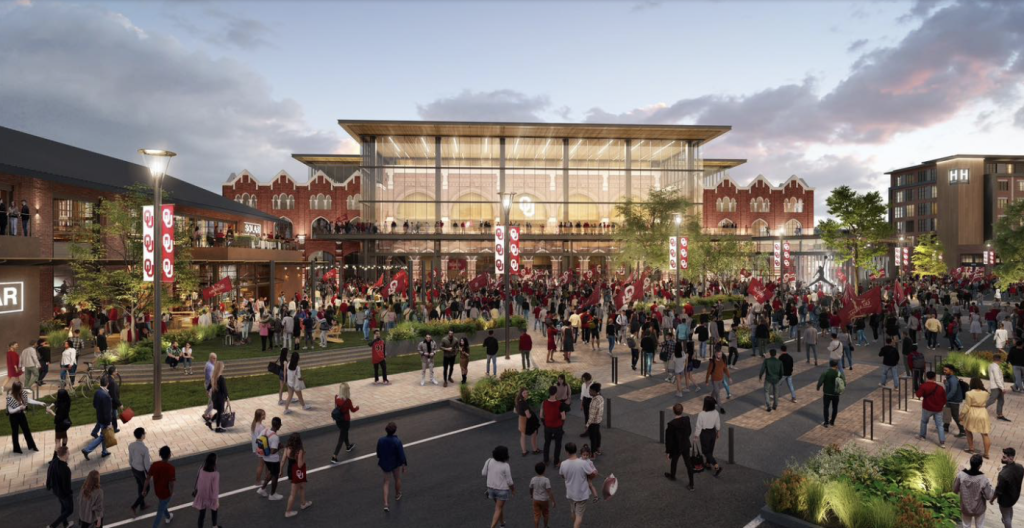
If you’ve been watching Norman real estate lately, you’ve probably heard the headline: the Rock Creek Entertainment District—often described as a $1+ billion development—has cleared major legal hurdles and is expected to move forward.
For homeowners, buyers, and investors, the obvious question is the same one that pops up anytime a massive project gets approved:
Will Rock Creek Entertainment District property values increase—and if so, where, when, and by how much?
Let’s break it down in a practical way, without hype. We’ll cover what’s planned, how projects like this typically affect home values, which parts of Norman could feel it most, and what could limit or delay the upside.
What is the Rock Creek Entertainment District (and where is it)?
The Rock Creek Entertainment District is planned for north Norman, near Rock Creek Road and 24th Avenue NW, close to I-35.
Public reporting and city materials describe a district anchored by a new University of Oklahoma arena/venue, plus surrounding retail, dining, entertainment, and related development.
A key piece of the story is the funding structure: the city’s plan has involved tax increment financing (TIF) with reporting noting more than $600 million connected to the city through the TIF mechanism.
And as of early 2026, the Oklahoma Supreme Court ruled against a referendum challenge tied to the project, widely seen as a “green light” for moving ahead.
Timing note: City leaders have discussed completion around 2029 (subject to phasing and construction realities).
How big developments typically influence property values
When people say “this will raise property values,” what they really mean is: it can change demand—and demand is what pushes prices.
Here are the most common value drivers that come with a major entertainment district:
1) Convenience and “amenity lift”
More restaurants, shopping, events, and walkable gathering spaces can increase buyer interest—especially for people who want to be near “where things are happening.” In many markets, that creates a modest but real price premium for nearby homes.
2) New jobs and new households
A district of this scale usually means construction jobs first, then permanent roles in hospitality, retail, events, and management. More jobs can translate to more households—and more households increase competition for housing.
3) Infrastructure upgrades
Large districts often trigger road improvements, utilities work, and better connectivity. If the surrounding area becomes easier to access and more polished, perception improves—and perception matters in housing.
4) “Confidence effect”
Even before opening day, markets react to certainty. Once legal and political uncertainty drops, builders, employers, and buyers tend to treat the plan as real, not hypothetical. The Supreme Court decision helps on that front.
The short answer: Yes, it can raise values—selectively
The most realistic takeaway is this:
Rock Creek Entertainment District property values are more likely to rise in specific pockets of Norman than citywide overnight.
Big projects rarely lift every neighborhood equally. The effect usually shows up like a ripple:
- Closest areas feel it first (sometimes even during construction, depending on the buyer pool)
- Mid-range areas may benefit later as new amenities become established
- Unrelated areas may see little direct impact beyond general city growth
Where Norman might see the biggest value pressure
This is not a precise “map,” but it’s a useful framework for thinking like a buyer (or appraiser).
Areas most likely to benefit
North Norman / I-35 corridor-adjacent neighborhoods typically see the most direct “amenity lift” when major development lands nearby—especially when the site is near highway access.
Look for micro-factors like:
- Easy routes to Rock Creek Rd / 24th Ave NW
- New or improving commercial nodes nearby
- Areas already trending upward in buyer demand
Areas that could benefit indirectly
Some parts of central Norman may benefit if the district truly pulls entertainment spending back into Norman (instead of residents driving to OKC). That’s been part of the public conversation around the project’s economic rationale.
Areas that could see mixed effects
The “closest homes” to major venues sometimes experience a tradeoff:
- Pro: walkability, short commute to events and dining
- Con: event-day traffic, noise, and parking spillover
That can mean values rise, but not as fast as homes that are close—but not too close (think: a short drive, not a street-over situation).
Timing: when could the housing market actually feel it?
In real estate, the price impact typically happens in phases:
Phase 1: Certainty and early momentum (now–pre-construction)
Once headlines shift from “might” to “will,” you can see:
- more investor interest
- more new-home planning in the broader area
- more buyer curiosity about nearby neighborhoods
The Supreme Court ruling increases that “certainty” factor.
Phase 2: Construction and disruption (mid-term)
Construction can be a value headwind for homes immediately adjacent to work zones—dust, traffic changes, and general inconvenience.
But at the same time, construction can also be a value signal that the plan is real.
Phase 3: Opening + performance (long-term)
The biggest boost tends to come after opening, when:
- businesses are operating
- events are consistent
- the district proves it can attract visitors beyond OU game days
If the district becomes a year-round draw—as proponents describe—then the “amenity lift” becomes easier to price in.
What could limit property value gains?
It’s smart to acknowledge the potential brakes.
1) Traffic and quality-of-life concerns
If event traffic becomes a constant headache in nearby residential areas, some buyers will avoid the immediate radius.
2) Tax and budget debates
The use of TIF has been controversial, and critics argue about city financial tradeoffs. Even if homes near the district benefit, broader sentiment and policy decisions can shape long-term growth patterns.
3) “Cannibalization” vs. net-new spending
A key question is whether spending is truly new to Norman or just redirected from other local businesses. Public materials have discussed both the idea of recapturing spending and the need to account for cannibalization.
4) Housing supply response
If the district triggers significant new housing supply (apartments, multifamily, nearby new subdivisions), that can absorb demand and soften price spikes—especially for entry-level homes.
What buyers and homeowners can do right now

If you’re trying to make a decision in the next 6–18 months, here’s a grounded approach.
For homeowners
- Track nearby comparable sales (not just citywide averages)
- Watch for infrastructure announcements and road plans
- Consider “close but buffered” positioning if you plan to sell in the next few years
For buyers
- Decide whether you want “event proximity” or “event convenience”
- Look at commute patterns: I-35 access can matter as much as venue proximity
- Avoid overpaying based on future promises—buy a home that works for you today
For investors
- Focus on renter demand drivers (jobs, universities, commuting access)
- Be realistic: value increases may be gradual until the district is operating at full strength
- Pay attention to phasing updates and timelines discussed publicly
Bottom line: likely uplift, but location and timing matter
So—will the $1+ billion Rock Creek Entertainment District increase property values in Norman? The most evidence-based answer is:
- It’s likely to create upward pressure on values, especially in north Norman and nearby areas that benefit from new amenities and improved perception.
- The impact will probably be uneven, with the “sweet spot” being close enough to enjoy access, but far enough to avoid the worst event-day friction.
- The biggest gains typically come after opening, when the district proves year-round demand.
FAQs
What is the Rock Creek Entertainment District in Norman?
It’s a planned entertainment and mixed-use development in north Norman near Rock Creek Road and 24th Avenue NW, anchored by a new OU arena/venue with surrounding dining, retail, and related uses.
Will Rock Creek Entertainment District property values go up right away?
Some nearby areas can see increased interest once a project becomes “certain,” but the biggest, most measurable uplift often happens closer to opening and after the district proves consistent demand.
Which Norman neighborhoods may benefit most?
Areas with easier access to the district site and I-35—generally north Norman corridors—are most likely to feel the strongest amenity effect first, though the exact impact varies block by block.
Could the entertainment district hurt nearby home values?
It can create mixed effects very close to the venue (traffic, noise, parking). Often the best price performance is “close but buffered,” depending on road access and neighborhood layout.
When is the district expected to be completed?
Public reporting has cited a target timeframe around 2029, though construction schedules can change based on phasing and approvals.
Final Thoughts
If you want, tell me the cross streets or neighborhood you’re curious about (or a few listings you’re watching), and I’ll share a quick, practical “likely impact” read—strong, moderate, or minimal—based on proximity, access, and common resale patterns. Daniella Miller
One response to “Rock Creek Entertainment District property values: Will Norman Home Prices Rise with the $1.1B Project?”
[…] Rock Creek Entertainment District property values: Will Norman Home Prices Rise with the $1.1B Proje… […]